The Wired Care Home: Making Technology Safe For Residents

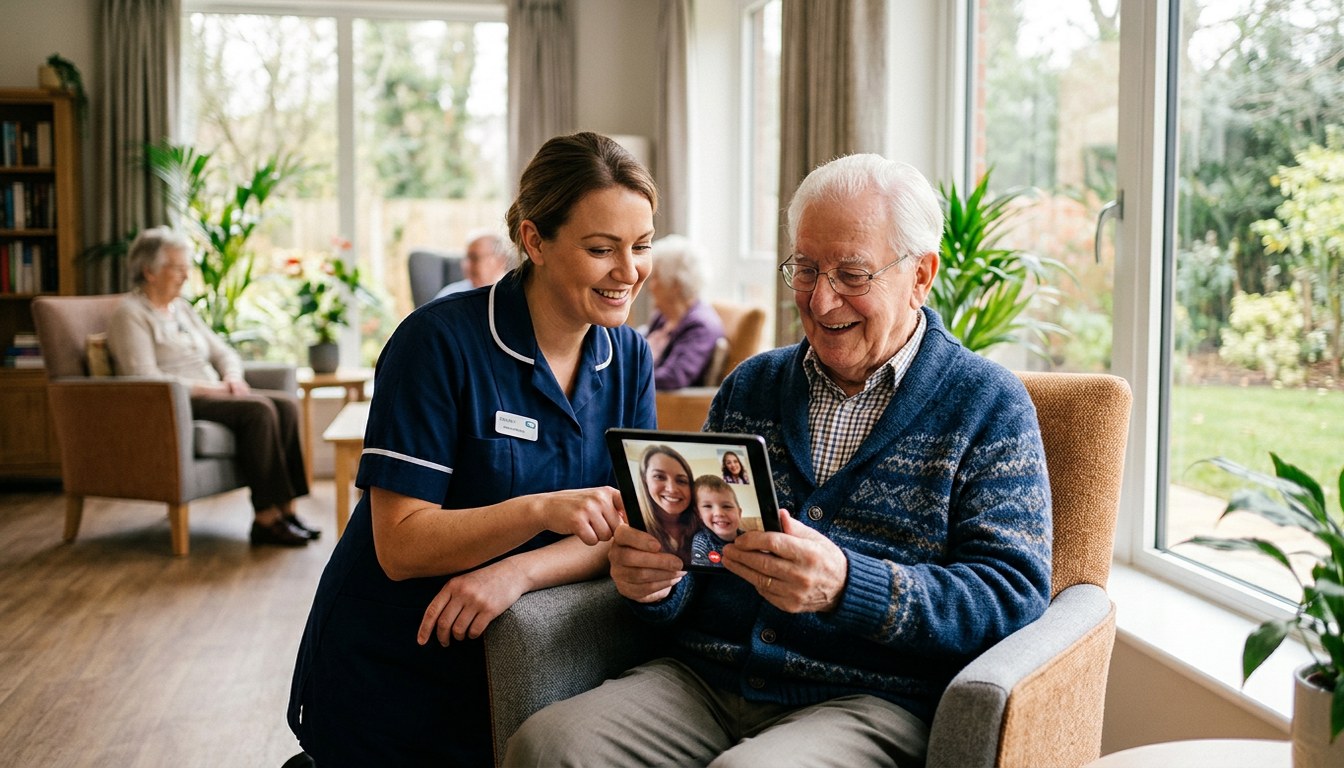
Many care homes now offer wifi, tablets and video calls, but not the security, privacy or staff training to go with them. The sector has the tools. What it has not built is the habits.
Key Findings
million
Email scams reported in the UK, January 2024
Adults without home internet who are 65 or over
million
Over-65s scammed online in the past year
If a hotel handed every guest a key but fitted no lock to the door, and then pointed to the closed door as proof of security, we would call that a promise the building could not keep. We would not call it hospitality.
Yet that is the arrangement in a great many care homes. Wifi, tablets and video calls are now offered as standard comfort, and residents are encouraged to use them to see family, join a virtual appointment or pass an afternoon. What is often missing is the lock: a connection that holds, a device that belongs to one person, and somebody on shift who knows how to help.
The Communications Consumer Panel, which studied whether residents' communications needs are actually met, found that many homes offer only a basic connectivity package. That means communal landline phones, a television in the room with Freeview, and home-wide wifi that is often unreliable. Communal devices are hard to access and deprive residents of privacy when they make a call. Where a resident does have good connectivity, the panel found it is usually a family member who arranged it.
Key Statistics
- 24 million: email scams reported in the UK as of January 2024
- 83%: share of UK adults without home internet who are aged 65 or over
- 1.8 million: over-65s scammed online in the past year, at an average loss of £831
- 61%: people aged over 65 who have been the target of fraud or a scam
- 1.7 million: people aged 75 and over who do not use the internet at all
- £12 million: government funding for carer courses and qualifications, announced in April 2025
- 4.2 million: fraud incidents recorded in the year to March 2025, a rise of 31%
The Basic Package
The panel's study is the right place to start because it asked the question the sector tends to skip. Its conclusion was that the care landscape does not meet many people's needs around connection. Many residents are digitally excluded and unable to participate in the outside world because of a lack of basic infrastructure: good wifi, phone signal throughout the home, and the right devices.
It also found the belief that stops change. Many staff interviewed felt that residents would not necessarily benefit from improved connectivity, and there were few examples available to them showing the difference it could make. That is not negligence. It is a gap in evidence and in training, and it closes as soon as somebody demonstrates what the screen can do.
The Lock On The Door
Security is the part that gets deferred. Care England's guidance for homes sets out the risks plainly: data breaches exposing resident and staff records, ransomware that encrypts critical files until a ransom is paid, phishing messages that trick staff or residents on the wifi into sharing information, and network weaknesses in outdated hardware and software.
The scale of the phishing problem is not hypothetical. As of January 2024, more than 24 million email scams had been reported in the UK.
The sector's own advice is unglamorous: encrypted wifi networks with strong passwords, updates applied, and passwords that are not shared, written down, or stored outside a password manager. A care home that hands out a tablet without securing the network has not given anyone access to the world. It has given them access to whoever else is on that network.
What The Screen Is For
The Welsh Government's good practice guide for care homes, published in October 2025, starts with why rather than what. Digital tools keep residents connected to families, provide a platform for virtual consultations with health services, and keep people occupied and engaged in meaningful activity.
The guide lists the benefits as residents report them: maintaining relationships, calm, entertainment, potential physical health improvements, improved wellbeing, and having something to do. Loneliness and isolation cause stress and anxiety, and digital tools help residents maintain relationships with people outside the home.
One home quoted in the guide used tablets to celebrate Sir Tom Jones turning 80, running a quiz about him and playing his music videos across the decades. The guide's comment is the point of the whole document: that activity would not have been possible before.
The Building Blocks
The guide also sets out what has to be in place first, and none of it is expensive. Staff and leadership buy-in, because not everyone is comfortable with technology and some feel they are not confident using it. A quality internet connection, which the guide acknowledges is a challenge when you do not know where to start. Devices such as tablets. And a Digital Champion.
That last idea is the most transferable in the document. A Digital Champion helps others build confidence and skills, and does not need to be an expert. They need basic digital skills and the patience, enthusiasm and willingness to help. There may already be someone in the home who fits.
The guide points homes towards gigabit broadband voucher schemes that could fund the connection, and towards Age UK's Digital Champion Programme as a working model of how volunteers are trained and deployed.
The Money And The Training
The government has started to put money behind the skills gap. In April 2025 the Department of Health and Social Care announced a new qualification to equip care leaders to use and deploy technology across care homes. It covers motion sensors that alert staff when someone has fallen, video telecare for remote appointments, and artificial intelligence that automates note taking or predicts care needs. It came with £12 million to fund courses and qualifications for carers.
Wes Streeting, then Health and Social Care Secretary, said the aim was to harness technology to help people live independently in their own homes and improve the quality of care.
The Digital Care Hub provides free information and guidance to providers making the transition. The tools exist, and the funding has started. The gap is who teaches the staff to use them, and who is accountable when nobody does.
What Needs to Happen
Treat connectivity as infrastructure, not a perk: A communications package that stops at a communal phone in the corridor is not a service. It is a gesture.
Give every home a Digital Champion: The Welsh model works because it does not require an expert, only somebody patient with basic skills and the time to sit with a resident while they learn.
Train the staff before the residents: The £12 million and the new qualification are the right shape. Skills are the bottleneck in this sector, not the hardware.
Make privacy the default: A shared tablet in a corridor is not a way to speak to your daughter. Devices should belong to a person, and a call should not require an audience.
Secure the network before handing over the device: Care England's advice is cheap, unglamorous and effective. It should be the condition of offering residents wifi at all.
A care home that offers wifi but not safety, devices but not privacy, and screens but not skills has not connected anyone to the world. It has given them a window they cannot open.
Key Data Summary
| Metric | Figure |
|---|---|
| Email scams reported in the UK, January 2024 | 24 million |
| Adults without home internet who are 65 or over | 83% |
| Over-65s scammed online in the past year | 1.8 million |
| Average loss per over-65 scam victim online | £831 |
| Over-65s targeted by fraud or a scam | 61% |
| People aged 75 and over who do not use the internet | 1.7 million |
| Government funding for carer qualifications, April 2025 | £12 million |
| Fraud incidents recorded, year to March 2025 | 4.2 million, up 31% |
Methodology
This analysis draws on:
- Consumer research: the Communications Consumer Panel's study of whether the communications needs of residents in care homes are being met, which examined availability, affordability, flexibility and security of services in residential settings.
- Sector guidance: Care England's guidance on internet security measures in care homes, published 29 July 2024, and the Welsh Government's digital good practice guide for care homes, published 1 October 2025.
- Government policy: the Department of Health and Social Care's announcement of a digital leadership qualification for care leaders and £12 million of funding for carer qualifications, published 9 April 2025.
- Provider bodies: the Digital Care Hub's free guidance for adult social care providers on making the most of digital technology.
- Charity and regulator data: Age UK's digital inclusion briefing; Ofcom's Media Use and Attitudes report as reported in April 2026; Good Things Foundation and Virgin Media O2's research on online scams, published 7 October 2025; and the Office for National Statistics' fraud and computer misuse figures for the year ending March 2025.
All figures are reported as stated by the organisations named. Where a proportion is quoted, it is the proportion reported by the source rather than one calculated here.
Sources
12 SourcesPrimary Sources
2021
- Many care homes offer only a basic connectivity package, including communal landline phones, televisions with Freeview and often unreliable home-wide wifi
- Communal devices are hard to access and deprive residents of privacy when making calls
- Where residents have good connectivity it is often because a family member arranged it, with major benefits for quality of life, dignity and independence
- Many staff interviewed felt residents would not necessarily benefit from improved connectivity
29 July 2024
- Common risks include data breaches, ransomware attacks, phishing scams and network vulnerabilities
- More than 24 million email scams had been reported in the UK as of January 2024
- Recommended measures include encrypted wifi networks with strong passwords and never sharing login information
- Passwords should not be written down or stored outside a password manager
1 October 2025
- Digital technology helps families stay connected, provides a platform for virtual health consultations and keeps residents occupied and engaged
- Reported benefits include maintaining relationships, calm, entertainment, improved wellbeing and having something to do
- Building blocks include staff and leadership buy-in, a quality internet connection, devices, and a Digital Champion
- A Digital Champion does not need to be an expert, only to have basic digital skills and the patience to help others
- One home quoted in the guide used tablets to celebrate Sir Tom Jones turning 80 with a quiz and music videos, which the guide notes would not have been possible before
9 April 2025
- A new qualification will equip care leaders to use and deploy technology across care homes and other settings
- Covered tools include motion sensors detecting falls, video telecare for remote appointments and AI that automates note taking or predicts care needs
- £12 million will fund courses and qualifications for carers to develop new skills
- The Health and Social Care Secretary said the aim was to harness technology to help people live independently and improve the quality of care
Sector and Workforce Guidance
- Provides free information, guidance and support to help adult social care providers make the most of digital technology
- Loneliness and social isolation affect physical and mental health and add pressure to health and social care services
- Technology is not a substitute for human interaction, but offers a lifeline to older people and supports carers to work more effectively
11 June 2026
- Volunteers support older people to develop digital skills and confidence
- Older people gain longer-term motivation to stay online
Data and Statistics
July 2025
- 29 per cent of people aged 75 and over in the UK, around 1.7 million, do not use the internet
- Nine per cent of people aged 65 to 74, around 0.6 million, do not use the internet
2 April 2026, reported by ISPreview
- Six per cent of UK adults have no home internet access
- 83 per cent of that offline group are aged 65 or over, with 66 per cent aged 75 or over
7 October 2025
- More than 1.8 million over-65s have been scammed online in the past year, with the average victim losing £831
- 61 per cent of Britons say bank closures are forcing over-65s to rely on online services
26 March 2026
- Around 4.2 million incidents of fraud recorded in the year ending March 2025
- A 31 per cent increase on the 3.2 million incidents recorded in the previous year
8 October 2024
- 61 per cent of over-65s have been the target of fraud or a scam
- Average reported loss of £3,798.70 per victim
Related Articles
REGIONAL BREAKDOWN: London pays highest but still below minimum required
New analysis reveals regional variations in funding crisis with London paying £26.83/hr (highest) but still falling short of £32.23/hr needed.
Policy Response: Government announces funding review
Minister responds to crisis with comprehensive review of home care funding structure.